What is ClientForce AI?
ClientForce AI is an AI sales automation platform created to keep pipeline activity moving without requiring a human to perform every repetitive action. Instead of bouncing between a lead source, inbox, calling app, scheduler, CRM, and proposal tool, users can launch AI sales agents that manage most of the front-end workload from a single dashboard.
From a business-model perspective, this product sits in an interesting place because it touches client acquisition, outbound automation, conversion support, sales enablement, and agency delivery at the same time. That opens several paths: a solo consultant can use it to stay visible with prospects, a service business can shorten response time, and an agency can turn the platform into a managed appointment-setting or sales automation offer.
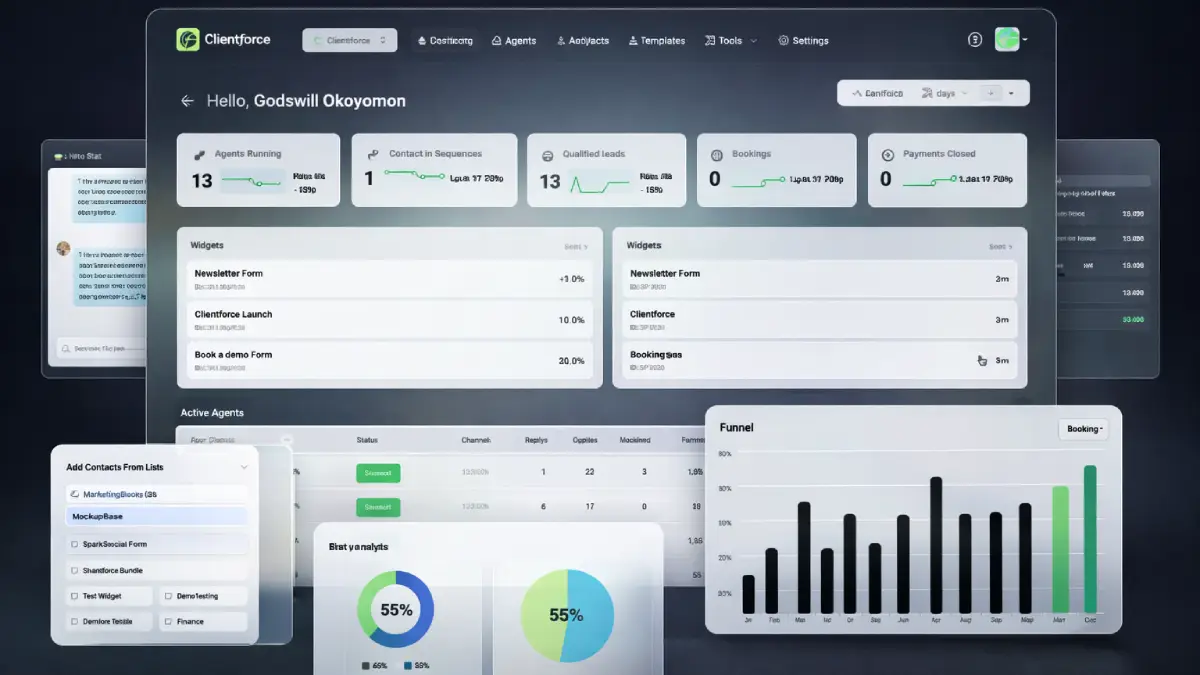
How it works (3 simple steps)
- Step 1 — Launch your AI Sales Agent: The setup starts with the campaign objective. You can choose a playbook, let the platform help generate one, and then load the business context that the AI needs to sound informed. That may include pricing, offer pages, PDFs, case studies, and sales materials, so the agent can talk about the service with more accuracy instead of acting like a generic chatbot.
- Step 2 — Feed the pipeline: Once the campaign is configured, ClientForce AI can pull in prospects through automated prospecting, imported contact lists, CSV uploads, or the embedded website agent. The practical advantage here is continuity: new contacts are not just collected, they are routed into the correct follow-up flow automatically.
- Step 3 — Let the system run sales activity: After activation, the AI handles message sequences, answers basic questions, places voice calls, nudges prospects toward booking, and can generate proposals when needed. That makes the platform less like a simple outreach tool and more like an always-on sales assistant that keeps conversations moving toward a next step.
See how ClientForce AI works
Step-by-step walkthrough from my YouTube channel

Key features that matter
The reason ClientForce AI is more interesting than a basic outreach app is the operational range. This is not limited to writing a few cold emails. It covers the whole motion from finding prospects to continuing the conversation after they reply, which makes it relevant for users trying to create an engine rather than a one-off campaign.
- AI sales agents: the platform launches agents that can prospect, respond, follow up, and keep deals moving without requiring a manual touch at every step.
- Automated lead prospecting: new leads can be discovered and verified continuously, which helps reduce the stop-start rhythm that ruins many outbound systems.
- Multichannel outreach automation: campaigns can stretch across email, WhatsApp, SMS, LinkedIn, and AI voice so conversations do not depend on one inbox alone.
- AI voice calls and booking: the voice layer can handle first-line interaction, answer common questions, suggest times, and increase the number of prospects who reach a call stage.
- Website-embedded AI agent: the on-site assistant can engage visitors in real time, collect details, and route them toward booking without waiting for a human rep.
- Automated proposal generation: proposals can be assembled from uploaded pricing, proof, and case studies, which shortens the gap between interest and offer presentation.
- Business knowledge training: PDFs, URLs, pricing pages, and reference material can be uploaded so the AI has context about the business instead of using shallow generic copy.
- Unified conversation inbox: replies, calls, proposal activity, and ongoing interactions sit in one dashboard, making oversight much simpler.
- Lead capture and routing: contacts from prospecting, widgets, uploads, and manual entry can be pushed automatically into the right campaign path.
- Workflow and integration automation: webhooks and app connections make it easier to trigger CRM updates, alerts, registrations, calendar actions, and payment links.
- Done-for-you playbooks: ready-made campaign frameworks lower setup friction, which matters for users who want momentum faster.
- Deliverability and compliance controls: sending limits, quiet hours, and reputation protections help keep scaling attempts from damaging sender health too quickly.
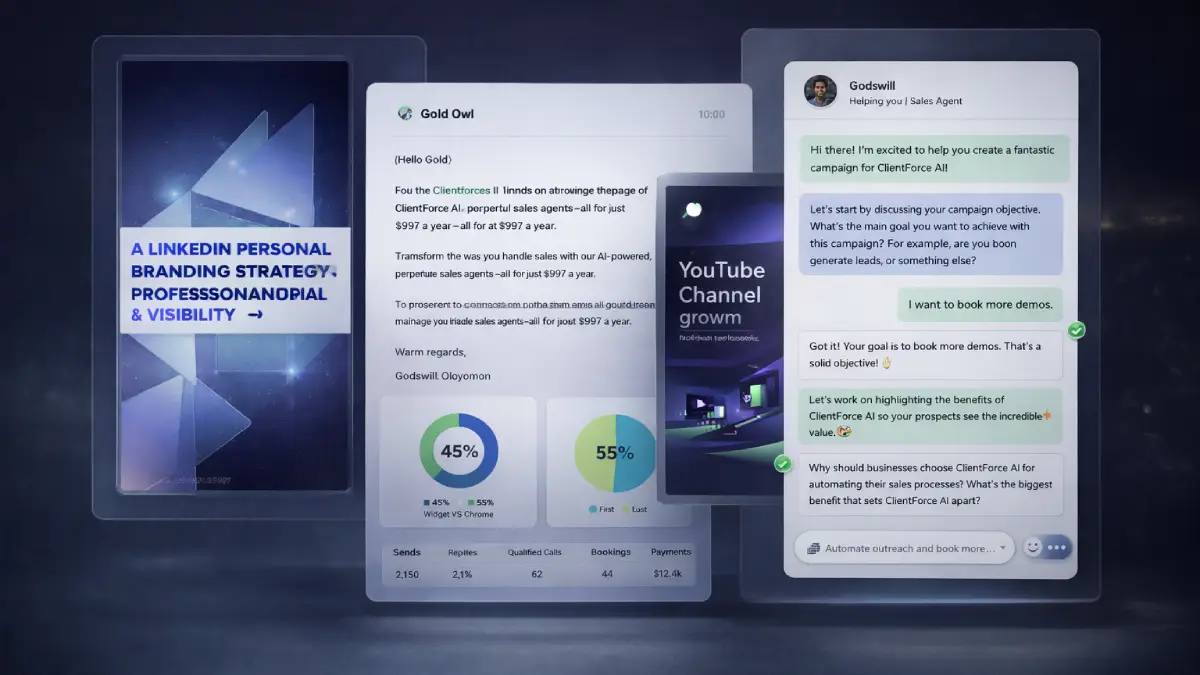
Pros & Cons (realistic)
Pros
- It targets a painful bottleneck: many businesses do not need more theory around sales; they need consistent execution, and this platform is positioned around that exact gap.
- The multichannel stack is commercially useful: combining email, messaging, voice, booking, and proposals in one flow is stronger than relying on a single outreach method.
- Good fit for service businesses and agencies: the client-facing use case is straightforward, especially for appointment-setting, lead generation, and outbound retainers.
- Playbooks reduce setup drag: users do not need to invent every sequence from zero, which makes the product easier to deploy quickly.
- Website capture adds another monetization angle: it is not just for outbound lists; the embedded AI agent can help convert existing traffic into booked calls too.
Cons
- Automation will not rescue a weak offer: if the service, pricing, or positioning is poor, more outreach only scales the weakness faster.
- Compliance and list quality still matter: even with safeguards, users need judgment when running outbound campaigns across multiple channels.
- The bigger scaling advantages live deeper in the funnel: serious operators and agencies will probably feel the pull toward Pro, Unlimited, Agency, or Reseller quickly.
- AI conversations still require supervision: the system can save time, but live campaigns should still be monitored so messaging quality does not slip into generic automation noise.
My personal angle (how I’d use it)
- For agency lead generation: I would treat ClientForce AI as a managed outbound engine for local businesses, coaches, consultants, and service brands that need more booked calls but do not want to build the stack themselves.
- For creator-led service offers: a creator selling consulting, audits, or implementation could use the platform to turn audience interest into a more structured booking and follow-up system.
- For offer testing: I like the idea of running different playbooks and objection paths to see which promise, niche, or pricing angle actually gets meetings instead of relying on guesswork.
- For recurring revenue packaging: rather than selling one-off setup work, I would position this as monthly sales automation management with optimization, reporting, and booked-call support layered on top.
Bonuses
My main focus here is on whether the product can realistically help with sales execution, campaign automation, and service packaging, plus which tier makes the most sense depending on whether you want a starter setup or a broader commercial license. For the full bonus list and delivery details on Tool Review Central, use the internal page below:
Bonus details
See what’s included and how delivery works after purchase.
Quick buying decision (what I’d pick)
If I wanted the full commercial stack in one payment, I would lean toward the ClientForce AI Bundle because it folds the front end together with Pro, Unlimited, Agency, and Reseller. That gives the broadest room for both execution and monetization. The Front-End is the sensible entry if you mainly want the core sales-agent system first. OTO1 Pro is the upgrade for users who want stronger customization and more advanced playbooks, OTO2 Unlimited is the scale layer for higher campaign volume, OTO3 Agency is the practical move for client management, and OTO4 Reseller is the biggest business-model expansion for users who want to sell the software as their own service.
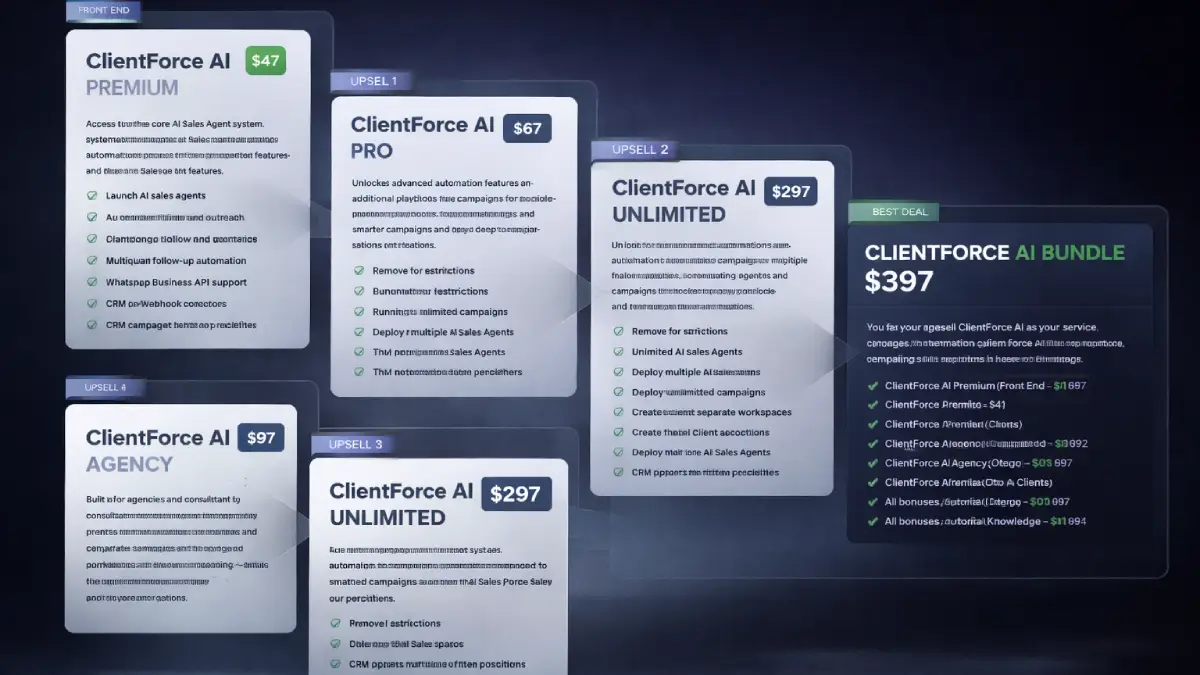
Pricing & funnel breakdown
| Offer | Price | Best for |
|---|---|---|
| Bundle — ClientForce AI Bundle | $397 | Best overall fit for buyers who already know they want the full ecosystem at once. Includes ClientForce AI Premium, Pro, Unlimited, Agency, and Reseller, plus bonuses, tutorials, and knowledge-base access. Strongest option for users aiming at both delivery and monetization from day one. |
| Front-End — ClientForce AI Premium | $47 | Core access to the AI Sales Agent platform. Includes automated prospecting, multichannel outreach, calendar sync, meeting booking, AI voice and telephony integrations, WhatsApp support, CRM and webhook connectivity, payment integrations, plus lead enrichment and verification. Good for getting the main automation engine live without buying the entire stack first. |
| OTO1 — ClientForce AI Pro | $67 | Best for users who want more control and sharper campaign performance. Adds extra AI playbooks, deeper workflow customization, premium templates, and stronger personalization options for smarter outbound sequences. |
| OTO2 — ClientForce AI Unlimited | $297 | Built for scaling. Removes campaign restrictions, supports multiple AI Sales Agents, and makes more sense for businesses running continuous outreach, demo-generation, trial conversion, or higher-ticket automation campaigns. |
| OTO3 — ClientForce AI Agency | $97 | The natural choice for agencies and consultants managing several client accounts. Adds separate workspaces, client-specific agent deployment, centralized monitoring, and a cleaner structure for selling outbound automation as a service. |
| OTO4 — ClientForce AI Reseller | $497 | A bigger expansion for entrepreneurs who want to resell ClientForce AI and keep the revenue. Best suited to users interested in building a white-label style offer around AI sales automation rather than only using the platform internally. |
Direct links (bundle first)
Open in a new tab. These are affiliate links.
FAQ
Is ClientForce AI mainly an outreach tool, or does it cover more of the sales process?
It goes beyond simple outreach. The pitch revolves around AI sales agents that can prospect, follow up, place voice calls, book meetings, generate proposals, and manage conversations across channels instead of stopping at first contact.
Can beginners use ClientForce AI without building a complex tech stack?
Yes. That is one of the core appeals. The product is aimed at users who want automation without stitching together multiple separate apps for prospecting, messaging, voice, booking, and workflow logic.
Who should seriously consider Unlimited, Agency, or Reseller?
Users planning to run larger outbound volumes or manage automation for multiple clients are the most obvious candidates. Unlimited is about scale, Agency is about organized client delivery, and Reseller is for users who want the broadest profit model.
Do you have a bonus page?
Yes — bonus info is here: /bonus/.
About the reviewer

Samuel Marco
I publish hands-on reviews of AI software and online business tools, with an emphasis on practical workflows, monetization potential, and whether a product can realistically help someone produce more output, save time, or build a marketable service around it.
Final verdict
ClientForce AI is aimed at one of the most expensive problems in online business: inconsistent sales follow-through. By bringing AI prospecting, multichannel messaging, booking, voice interaction, proposal generation, and workspace management under one roof, it offers a cleaner path to building a repeatable outbound system without relying on constant manual effort. The wider funnel adds more room for scale, customization, agency delivery, and software resale, which means the offer can stretch from solo operator use all the way to a packaged client business. The bigger question is not whether the platform can automate actions. It is whether the user has a credible offer, good targeting, and enough judgment to turn the automation into booked calls and closed deals instead of noise. For buyers who want a practical AI sales automation platform with obvious commercial applications, ClientForce AI has a strong case.
Want a faster way to automate prospecting, keep follow-up moving, book more meetings, and turn sales automation into your own internal system or client service?
The Bundle gives the broadest value. Front-End is the simplest place to start. OTO1 adds smarter customization, OTO2 unlocks scale, OTO3 supports agency delivery, and OTO4 opens the reseller path.