What is AdStorm?
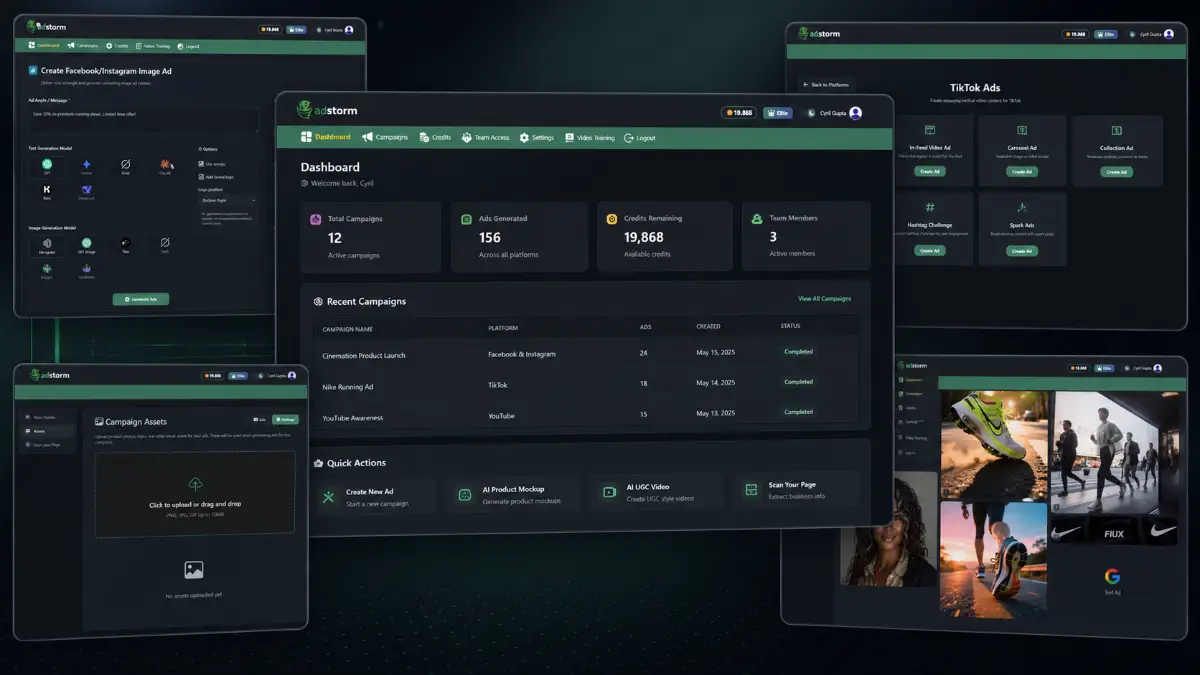
AdStorm is an AI-driven advertising creation platform built for marketers, ecommerce stores, agencies, creators, and businesses that need to produce ads across multiple channels without building every asset manually. Rather than focusing only on copywriting or image generation, the software combines ad copy creation, visual generation, video production, UGC-style content, carousel formatting, product mockups, platform optimization, and AI-assisted editing inside one workflow.
One of the more interesting parts of AdStorm is how it treats advertising as a repeatable content operation instead of a one-off creative task. Users can scan websites, pull product information automatically, generate multiple campaign angles, create platform-ready assets, and export several ad variations quickly . That makes the platform especially relevant for people managing high creative output — such as ecommerce testing, affiliate campaigns, social commerce, agency client work, or creator-led product promotion.
The practical value comes from production speed. Instead of designing separate creatives for Facebook, TikTok, Google, Instagram, YouTube Shorts, Pinterest, and Reddit manually, AdStorm restructures the content automatically around the requirements of each placement. For smaller operators, this reduces production friction. For agencies and advertisers, it creates a faster way to generate creative inventory for campaign testing and scaling.
How it works (3-step workflow)
- Step 1 — Build the campaign foundation: Start by adding your product details, offer positioning, business information, brand assets, and campaign goals. Users can also submit a website URL so AdStorm can automatically analyze the page and extract relevant messaging, product positioning, visuals, and branding details.
- Step 2 — Select the advertising channel and format: Choose where the campaign will run, including Facebook, Google, TikTok, Instagram, YouTube, Pinterest, Reddit, Quora, or X. Then pick the format you want to produce, such as image ads, carousel creatives, Shorts, Reels, search ads, UGC-style videos, or promotional video content.
- Step 3 — Generate, iterate, and export: AdStorm creates multiple ad variations complete with headlines, primary text, visuals, videos, hooks, CTAs, and creative formats. Users can edit assets manually, regenerate variations with AI prompts, test different ad angles, and download campaign-ready creatives for launch.
See how AdStorm works
Step-by-step walkthrough from my YouTube channel
Key features that matter
AdStorm is most interesting when you look at it through the lens of creative volume. Paid ads rarely improve because one perfect asset appears on the first try. They improve because marketers test hooks, formats, visuals, audiences, objections, proof angles, and calls-to-action until patterns appear. AdStorm gives users a faster way to create that testing inventory while still respecting the different requirements of each ad platform.
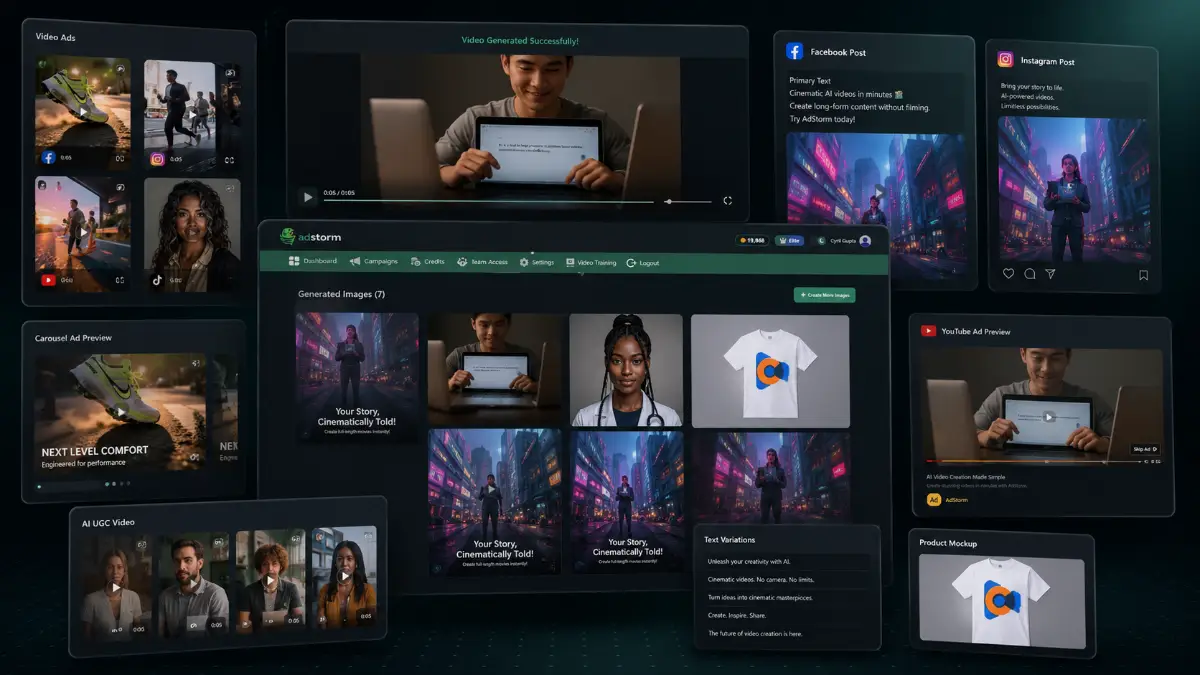
- Multi-platform ad creation: generate ads for Facebook, Instagram, Google, YouTube, TikTok, Pinterest, Reddit, Quora, and X with structure and formatting designed for each placement.
- AI ad copy generation: create headlines, primary text, descriptions, CTAs, short hooks, long-form angles, and multiple message variations for different campaign goals.
- Platform-ready creative formats: produce image ads, video ads, carousel campaigns, stories, Reels, Shorts, pins, promoted posts, and search ad assets without manually resizing everything from scratch.
- Multi-AI model access: use several AI engines for text, image, and video generation, including GPT, Gemini, Claude, Grok, Flux, Ideogram, Kling, and other creative models.
- AI ad angle generator: explore hooks based on convenience, savings, curiosity, urgency, pain points, benefits, emotional triggers, objections, and audience intent.
- Website scanning technology: enter a URL and let AdStorm pull product details, positioning, brand signals, page copy, benefits, and campaign inputs from the existing site.
- Image generation and editing: create ad visuals, resize layouts, regenerate alternatives, improve product photos, add text overlays, and build variants for different channels.
- Video ad creation: generate short promotional videos for TikTok, Instagram Reels, Facebook Ads, YouTube Shorts, and other video-first placements.
- UGC-style video generator: create avatar-based spokesperson clips with scripts, different presentation styles, and multiple resolutions for user-generated-content inspired campaigns.
- Product mockup creator: build branded mockups for ecommerce, merchandise, apparel, print-on-demand, digital products, and promotional visuals.
- Ad inspiration and cloning workflow: upload screenshots of existing ads so the platform can study layout, message structure, and creative style, then generate inspired variations for your own offer.
- Google Search ad generation: create search ads with multiple headlines and descriptions that follow Google-style ad structure and character limits.
- Multi-language campaign creation: produce ad assets in different languages for international testing, localized promotions, and multilingual audiences.
- Creative variation generation: quickly create new versions of the same ad to test hooks, visuals, headlines, calls-to-action, format choices, and creative concepts.
- AI-assisted editing: rewrite copy, simplify text, add emojis, change tone, make messages more direct, generate new angles, or polish creative elements with prompts.
Pros & Cons (realistic)
Pros
- Solves creative production fatigue: many advertisers can launch campaigns, but struggle to continuously produce enough fresh creatives. AdStorm dramatically increases ad production speed across multiple platforms.
- Built for modern ad ecosystems: the platform supports short-form video, UGC-style content, carousels, search ads, and social creatives instead of focusing only on static image generation.
- Strong for testing workflows: generating multiple hooks, visuals, headlines, and angles quickly makes it easier to test creative directions without rebuilding campaigns manually.
- Useful for agencies and ecommerce: website scanning, creative resizing, AI editing, and campaign variations reduce repetitive production work when managing multiple offers or clients.
- Multi-AI model access adds flexibility: users are not locked into a single generation engine, which improves creative diversity across copy, visuals, and video assets.
Cons
- Creative volume does not guarantee profitable ads: advertisers still need strong offers, targeting, positioning, and campaign management to achieve good results.
- AI-generated creatives still require judgment: some outputs may need editing, refinement, or stronger brand alignment before running paid traffic at scale.
- Credit-based systems can become limiting: users generating large numbers of videos, mockups, or creative variations may eventually need higher-tier plans or additional credits.
- Advanced media buyers may still use external tools: larger advertising teams often combine dedicated analytics, attribution, and editing systems alongside AI generation platforms.
My personal angle (how I’d use it)
- For ecommerce testing: I would use AdStorm to generate multiple creative angles around the same product quickly, then rotate hooks, visuals, and short-form videos aggressively to fight ad fatigue.
- For creator-led products: instead of publishing the same static ad repeatedly, I would turn YouTube clips, social posts, landing pages, and offer positioning into several platform-specific ad formats automatically.
- For agency workflows: the biggest operational gain would be reducing creative turnaround time for clients. Faster production means agencies can test more campaigns without expanding creative staff proportionally.
- For affiliate campaigns: I would treat AdStorm as a rapid ad variation engine, generating multiple ad directions around one offer before scaling spend into the best-performing creative combinations.
Bonuses
AdStorm is most valuable when the creative workflow is connected to a real acquisition plan. The software can generate the assets, but campaign results still depend on offer quality, audience selection, landing page strength, tracking, and follow-up. For the full Tool Review Central bonus list and delivery details, use the internal page below:
Bonus details
See what’s included and how delivery works after purchase.
Quick buying decision (what I’d pick)
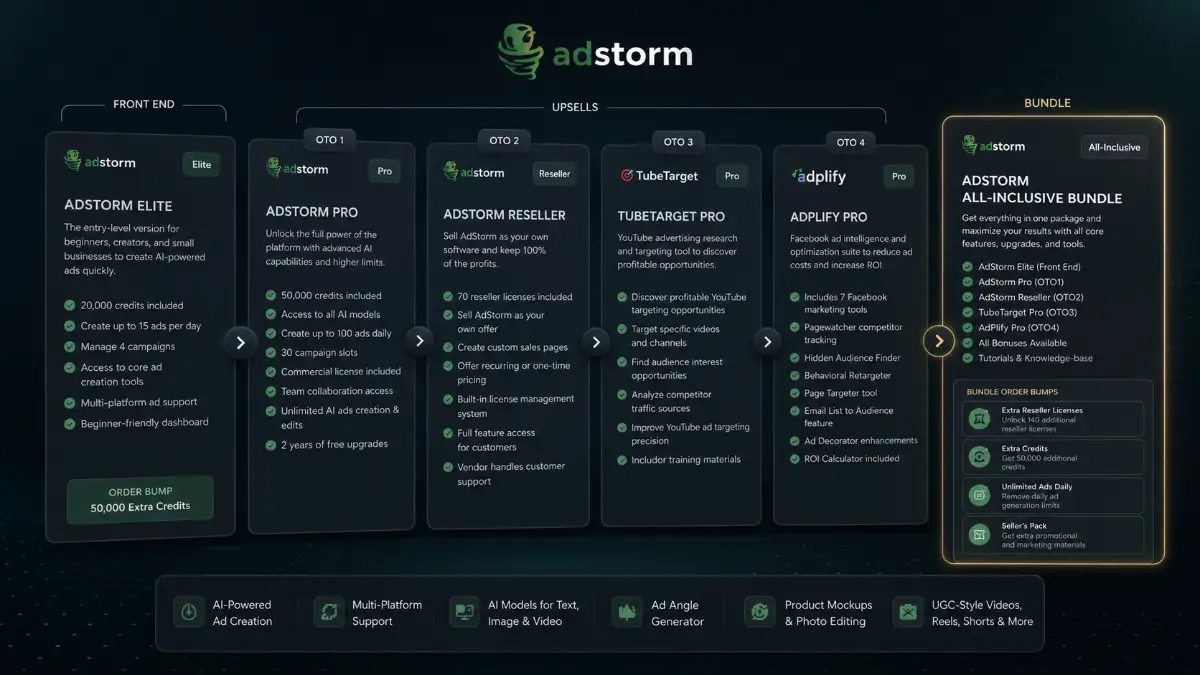
If I wanted the broadest setup from day one, I would look at the AdStorm Bundle first because it combines the Front-End, Pro upgrade, Reseller package, TubeTarget Pro, AdPlify Pro, all bonuses, tutorials, and knowledge-base access in one purchase. The Front-End is the lower-cost route for testing the core ad creation workflow. AdStorm Pro is the more realistic fit for frequent creators, agencies, ecommerce sellers, and marketers who need higher limits and access to all AI models. Reseller is for users who want to sell access. TubeTarget Pro supports YouTube ad research, while AdPlify Pro adds Facebook ad intelligence and optimization tools.
Pricing & funnel breakdown
| Offer | Price | Best for |
|---|---|---|
| Bundle — AdStorm All-Inclusive Bundle | $247 | Best overall route for buyers who want the complete AdStorm stack in one package. Includes AdStorm Elite, AdStorm Pro, AdStorm Reseller, TubeTarget Pro, AdPlify Pro, all bonuses, tutorials, and knowledge-base access. |
| Front-End — AdStorm Elite | $47 | Entry-level version for beginners, creators, small businesses, and marketers who want to create AI-powered ads quickly. Includes 20,000 credits, up to 15 ads per day, 4 campaigns, core ad creation tools, multi-platform ad support, and a beginner-friendly dashboard. |
| Order Bump — 50,000 Extra Credits | $49 | Optional credit expansion for users who plan to generate more ads, videos, visuals, AI content, and campaign variations inside the Front-End account. |
| Bundle Order Bump 1 — Extra Reseller Licenses | $99 | Adds 140 extra reseller licenses for users who want to expand software selling potential and distribute more customer accounts. |
| Bundle Order Bump 2 — Extra Credits | $44 | Adds 50,000 extra credits for buyers with higher creative production needs, more frequent testing, or multiple campaign projects. |
| Bundle Order Bump 3 — Unlimited Ads Daily | $14 | Low-cost limit remover for users who do not want daily ad generation caps inside the platform. |
| Bundle Order Bump 4 — Seller's Pack | $29 | Additional promotional and marketing materials for users who want more support selling or promoting AdStorm. |
| Upsell 1 — AdStorm Pro | $67 | Main upgrade for marketers, agencies, ecommerce sellers, and professionals. Includes 50,000 credits, all AI models, up to 100 ads daily, 30 campaign slots, commercial license, team collaboration, unlimited AI ad creation and edits, and 2 years of free upgrades. |
| Upsell 2 — AdStorm Reseller | $197 | For affiliates, agencies, entrepreneurs, and software sellers who want to sell AdStorm access. Includes 70 reseller licenses, custom sales pages, one-time or recurring pricing options, license management, customer feature access, and vendor-handled support. |
| Upsell 3 — TubeTarget Pro | $67 | YouTube advertising research and targeting tool for discovering profitable targeting opportunities, specific videos and channels, audience interests, competitor traffic sources, and stronger YouTube ad targeting precision. |
| Upsell 4 — AdPlify Pro | $67 | Facebook ad intelligence and optimization suite with 7 Facebook marketing tools, Pagewatcher competitor tracking, Hidden Audience Finder, Behavioral Retargeter, Page Targeter, Email List to Audience, Ad Decorator, and ROI Calculator. |
Direct links (bundle first)
Open in a new tab. These are affiliate links.
FAQ
Is AdStorm only an AI copywriting tool?
No. Copywriting is one part of the platform, but AdStorm also creates visuals, videos, carousel assets, UGC-style clips, product mockups, search ads, social ads, and creative variations for different platforms.
Which platforms does AdStorm support?
AdStorm supports major ad and content platforms including Facebook, Instagram, Google, YouTube, TikTok, Pinterest, Reddit, Quora, and X. The value is that the output can be shaped around the format and structure of the channel instead of forcing every ad into the same template.
Can AdStorm help ecommerce sellers?
Yes. Ecommerce and print-on-demand sellers can use it for product mockups, benefit-driven ad copy, short videos, image ads, product-focused hooks, creative variants, and multi-platform testing assets.
Do you have a bonus page?
Yes — bonus info is here: /adstorm-bonus/.
About the reviewer

Samuel Marco
I publish practical reviews of AI software and online business tools, focusing on real workflows, buyer use cases, monetization potential, pricing decisions, and whether a tool can realistically help someone save time, increase output, or package a service around it.
Final verdict
AdStorm fits the current direction of digital advertising surprisingly well because modern platforms increasingly reward advertisers who can produce large amounts of creative quickly. Facebook, TikTok, YouTube Shorts, Instagram Reels, Pinterest, Reddit, and Google campaigns all depend on constant testing, creative refresh cycles, and adapting content formats to different placements. AdStorm is designed around accelerating that entire production loop by combining copy generation, visual creation, UGC-style videos, ad formatting, website scanning, AI editing, and multi-platform asset generation inside one system.
The software is especially relevant for ecommerce brands, agencies, creators, affiliates, and marketers running campaigns across multiple traffic sources. Instead of building every ad manually, users can generate larger creative inventories faster and spend more time analyzing performance rather than assembling assets from scratch. The platform will not replace campaign strategy, targeting, or strong offers, but it can significantly reduce the operational friction involved in launching and iterating ads at scale.
Want a faster way to create AI-powered ads with copy, visuals, video creatives, UGC-style formats, product mockups, ad angles, and platform-ready variations?
The Bundle gives the widest setup. Front-End is the simplest way to test the core workflow. Pro increases limits and unlocks more serious usage. Reseller supports software selling, TubeTarget Pro helps with YouTube targeting, and AdPlify Pro adds Facebook ad intelligence and optimization tools.